Peru: Der Kartoffelertrag verdoppelte sich auf 6.58 Millionen Tonnen seit 2000, da die Erträge 19.5 t/ha erreichten
Peru erntete 6.58 Millionen Tonnen Kartoffeln in 2024, wie Daten von FAOSTAT zeigen, die von Our World in Data veröffentlicht wurden. Im Jahr 2000 produzierte das Land 3.27 Millionen Tonnen. Der Ertrag hat sich somit in etwa 24 Jahren verdoppelt.
The Ministry of Agrarian Development and Irrigation (MIDAGRI) gives a similar figure. It reported 6.52 million tonnes for 2024, against 5.43 million tonnes in 2023. FAOSTAT shows 5.46 million tonnes for 2023. Both sources point to a jump of about 20% in one year.
Nicht die Fläche, sondern der Ertrag trieb das Wachstum voran
Average yield rose from 11.5 t/ha in 2000 to 19.5 t/ha in 2024, according to FAOSTAT. In 2014 it was 14.8 t/ha. Harvested area moved much less. The ministry counted 313,606 harvested hectares in 2023, down from 330,790 hectares in 2022.
Die Produktion ist stark fragmentiert. Mehr als 710,000 Familien bauen Kartoffeln an, wie MIDAGRI angibt. Im Durchschnitt sind das weniger als 0,5 Hektar pro Familie. Die Produktion erstreckt sich über 19 Regionen, und etwa 90% konzentriert sich auf die Hochländer. Die größten Anbauflächen in 2023 lagen in diesen Regionen: Puno (54,960 ha), Huánuco (42,736 ha), Ayacucho (30,552 ha), Cusco (29,156 ha) und La Libertad (26,550 ha).
Potatoes are a core food. Consumption is above 95 kg per person per year, according to the ministry. The 2024 crop was worth S/ 8.314 billion. That equals 10.5% of the value of national agricultural production. The crop also generates more than 27 million working days per year. More than 4,000 potato varieties are registered in the country.
Wachstumspotenzial
A yield of 19.5 t/ha is still modest. FAOSTAT shows 35.8 t/ha in Argentina and 34.5 t/ha in Chile in 2024. Most Peruvian potatoes grow on small highland plots. Weather therefore moves the national total strongly from year to year.
Warum das wichtig ist
Peru is the largest potato producer in Latin America, according to MIDAGRI. Its supply depends on hundreds of thousands of small farms, not on a few large growers. The swing between 2023 and 2024 shows that national output can change by a fifth in one season.
Für Zulieferer von Pflanzkartoffeln, Düngemitteln und Maschinen bietet der Abstand zwischen 19.5 t/ha und etwa 35 t/ha in Nachbarländern die größte Chance. Für Käufer bedeutet die fragmentierte Lieferbasis jedoch schwankende Mengen und Preise.
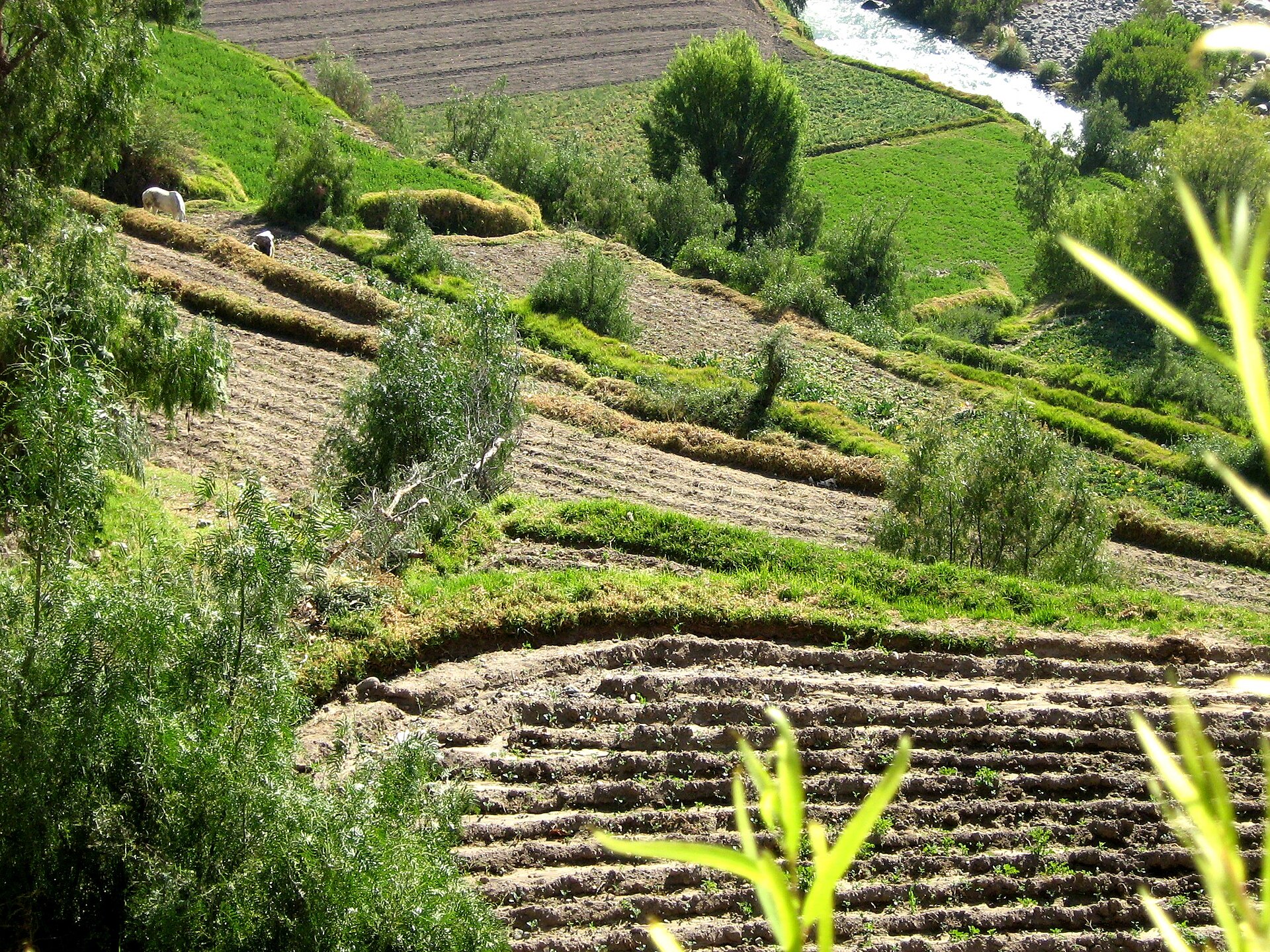
Photo: Terrace farming in the Andes, Peru (illustrative). J. Thompson / Wikimedia Commons, public domain